Submitted for Final Assignment, Category 2, Option 3
Note that my Category 2 is a “choose your own adventure” – an online, asynchronous, open (and cc-licensed) self-directed workshop, primarily aimed at my institution around created and integrating CC licensed materials into their courses. I built this workshop in WordPress, integrated various open resources and sharing options, and licensed the workshop under a CC BY-SA license.
Submitted for Final Assignment, Category 1, Option 2
The Option I chose for this first Category of the final assignment in my course is to “annotate the Additional Resources sections with either notes on what sources were most helpful or suggestions for additional sources to add.” I have created this annotation in a Google Sheet. In this sheet I am to:
Highlight or add at least five resources–one for each unit. Describe how/why they are relevant. Note where in the unit your resources build on ideas presented (citing the unit section number and paragraph).
Additionally, suggest at least 3 annotations for new resources to add from non-North American sources. Describe how/why they are relevant. See grading rubric for annotation requirements.
I chose this option as I think it might be useful to others (and useful to me to easily refer back to as I move forward promoting Open at our institution)!
Note that my Category 2 is a “choose your own adventure”, and will be posted on a separate WordPress site.
So, to give you a quick snapshot, I have chosen to highlight the following Additional Resources to annotate in order of Unit number:
As I finish up my Creative Commons course (stay tuned for my final assignments which are due on December 1), I have made a decision to use this blog space to post more of my own personal professional thoughts on edtech, elearning, and open education.
So, to get me started on posting things that are NOT part of assessments, I wanted to reblog a post by David Wiley reflecting on the recent UNESCO OER Recommendations report. I personally hope this report leads to post-secondary institutions making Open a priority, working with faculty and those of us who support them to implement mindful change to give students more options around quality educational materials at no cost to them, that they can also build on and share in their own practice.
So, without further ado, here is a link to David Wiley’s post:
Submitted for Assignment 5, Creative Commons for Educators
The goal of this post is to “produce a strategy or informational document in which you reflect on how the values and practices of the Creative Commons can (or already do) have a positive impact in a context that is important to you, and to confront a specific issue in that context where what you have learned can make a real contribution.” After several false starts, I finally settled on writing a more reflective piece, and to consider some more personal workplace goals.
When I think about Creative Commons, I recall all the sharing I have done with various colleagues over the past 30 or so years of working in educational technology and eLearning. And how much easier sharing has become over those 30 years as materials moved from simply electronic, to available on the Internet.
Back in the day, when I worked in DOS (remember DOS?) on computer assisted language learning (CALL), we used what basically amounted to open source software, developing language lab computer exercises we shared back to others in our CALL community across Canada. These programs were only available on individual computers, but we could share using floppy discs (you know, they looked like SAVE icons!).
Then I moved into the Learning Management System world where content was locked down, but we, as instructional designers in distance education, shared our practices and training materials with each other, as well with any instructor who had a yen for learning more, using URLs and email attachments.
Now, in my current position, a large part of my job is to develop training/development documents, courses, materials, etc. for faculty around integrating educational technology and digital pedagogies into their teaching – the technical hows, and the pedagogical whys. I create all of these materials under a CC-BY or CC-BY-SA license, and while they are first placed in our LMS for easy access for faculty, I now also blog them to the world.
So, we’ve come a long way, but one thing that has not changed over the years are issues of academic freedom and intellectual property, as well as questions of institutional “ownership”, and, sometimes, reticence by faculty to share. And even more now with the increase of Open Pedagogy, and the concept of the non-disposable assignment, we also face protecting the privacy of our learners (even if they are also faculty) and finding ways to support those not quite ready to share their learning experiences in an open space (as opposed to a more closed, safer feeling space).
To give you a better idea of my context before I talk about my own dreams and goals moving forward, I work as an instructional designer in an eLearning unit which is part of a larger teaching and learning centre at a mid-sized community college, and while I do work to advocate up the chain, much of my work creating, using, and promoting open happens at the one-on-one level with faculty and colleagues.
That being said, I am very grateful to have been given the opportunity, and institutional support, to engage in this Creative Commons certificate. Open is valued at our institution, particularly within the library where they have been providing students with low- or no-cost resource options for awhile now. Where we need to move now is in engaging with administration and faculty to show the benefits to not just students, but to the institution as a whole and to instructors facing a number of policy challenges (indigenization, interculturalization, inclusive design, accessibility, etc.) which OERs can help resolve. In other words, it should not be a checklist of separate things to add to your teaching, but supported as a holistic approach. This is a long-term challenge I cannot face on my own – I need to find and build a network of champions within my institution (librarians, faculty, administrators).
Luckily, I am not alone in facing challenges of promoting Open at a post-secondary institution. For example, just this week I received notice that Dr. Tannis Morgan (a past learner in this certificate) has published an article entitled “Getting to Openness at a Closed Institution: A Case Study of Evolving and Sustaining Open Education Practices” which is a great case study of how a BC institution has made OER a priority in spite of tensions to being open. In addition, we have BCcampus on hand to support Open initiatives within, and build connections between, post-secondary institutions across the province. Finally, I am curious to see how the new draft Unesco “UNESCO Recommendation on Open Educational Resources (OER)” will affect the way post-secondary institutions prioritize open within their mandate and policies both globally and locally.
My personal challenge, and one which I can realize more immediately, is to develop, host, and deliver open, asynchronous learning opportunities for our faculty, as well as to anyone who wants to avail themselves of them, and to encourage people to share back what they create and share back any improvements they make to the materials. For example, over the next 6 months, I will be creating asynchronous “workshops” in WordPress that are all licensed CC-BY-SA. I will also work with my colleagues to revise face-to-face workshops so they can also be shared online. At the same time, I can collaborate with others in BC around creating and revising CC tutorial resources, sharing out my revisions and remixes as I go.
All this sharing is sometimes tricky, not technically, but practically. In other words, how do you get the word out to people, how do you know if people are using the materials, and how do you encourage people to connect? I hope I am up to the challenge!
Submitted for Assignment 4, Using CC Licenses and CC-Licensed Works
Applying a CC license to your own work is a good first step to entering the wonderful world of sharing. Adopting or copying a CC licensed work and sharing it out (according to its license) is a good next step. But, there are other ways you can create new open educational resources (OER) through mixing and matching CC licensed creations already out there. So, in this assignment post for Unit 4 of the Creative Commons certificate, we explore remixes as adaptations/derivatives and collections.
When you mix (or remix) CC creations, you can either create an adaptation or derivative as a new creation, or create a collection. We’ll look at adaptations/derivatives first.
Adaptations/Derivatives
According to Unit 4 of the course, “to constitute an adaptation, the resulting work itself must be considered based on or derived from the original” which often involves rearranging a work in some way, while also inserting other creations and/or your own creation(s) into the whole mix, rather like you are cracking eggs into a bowl to create an omelette, or a delicious scrambled egg mixture.
Of course, you can also take one single work and create an adaptation of it by taking parts out, mixing parts up, etc. An adaptation doesn’t have to be a combination of multiple creations, for example taking an open textbook and using only some of its chapters, reordering them, removing sections, etc. to create a new version of the open textbook.
It’s important to note that “adaptation” is not defined the same way in every country, as you can see at the Creative Commons FAQ site. I find it interesting that some of these differences are dependent on what the law views as the “originality/creativity” of the adapted work, which in my mind are rather subjective concepts.
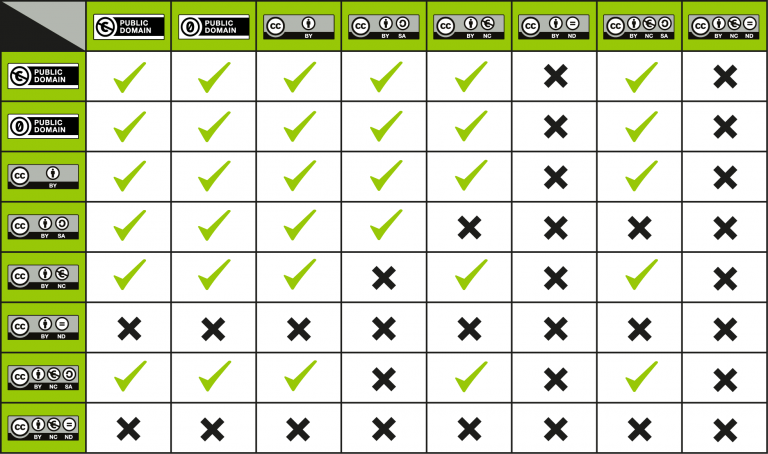
With regards to how you can license adaptated/derivative works, the important thing to keep in mind are the original licenses of the works you have adapted/mixed together. The license you apply needs to be compatible with ALL of the licenses. A good way to check is by using the License Compatibility Chart:
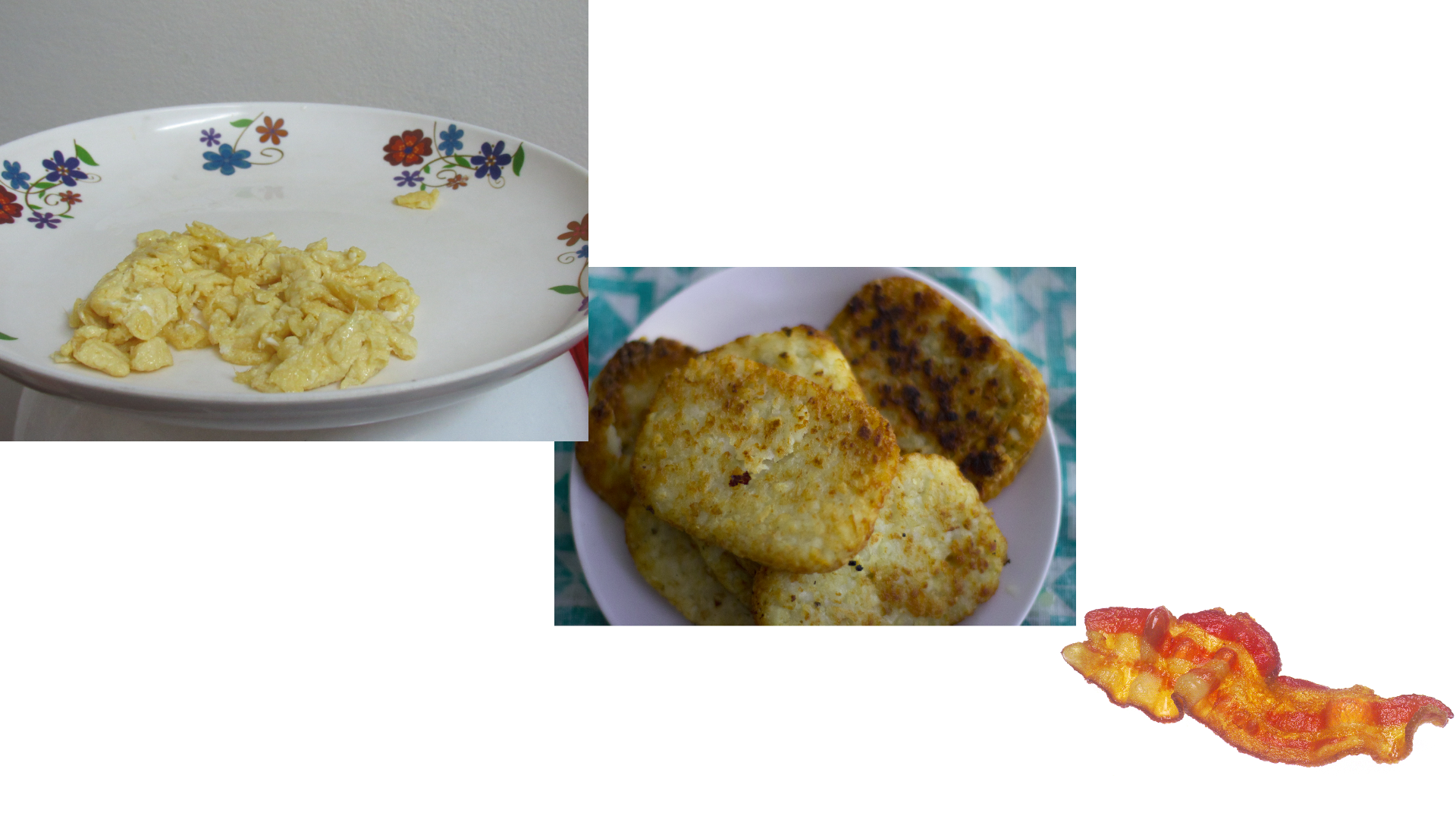
Now, a collection is a little different. Collections are simply that – collections of various CC-licensed works with no mixing, no rearranging, no changing the essence of the individual creations at all. Rather like creating a textbook or course pack where each chapter is an unchanged article or another textbook’s chapter, etc. The image I present below is a collection I created in Pixlr from CC-licensed images, inspired by my own hunger – I have simply taken three images and combined them into one whole without altering any one of them.
“Breakfast of Champions” CC BY-SA 4.0, compiled by Emily Schudel of “Scrambled eggs on a plate” by Afifa Afrin used under CC BY-SA 4.0, “Bacon” by Renee Comet, used underPublic Domain, and “A plate of hash browns” by Jason Zhang, used underCC BY-SA 3.0.
Note the licensing of this collection. The license I apply to the collection only covers the arrangement of the individual pieces I made. Each individual work retains its own license. But, as with the licensing of an adaptation, the license I apply to the collection must be compatible with the licenses of the individual creations.
The concept of a collection can sometimes be a bit confusing. I was wondering what I would consider this blog post to be: an adaptation or a collection. I think I would consider it to be a collection since each individual CC-licensed creation is unchanged, although I have added my own “stuff” to contextualize each creation. But, it could perhaps also be considered an adaptation since I have incorporated a collection in Breakfast of Champions. Christine Hendricks, in her submission for this same assignment last year, asked similar questions about the boundaries that define the distinction between collections and adaptations. I will need to take more time with this concept before I feel 100% confident in my understanding of it! Either way, the license I have applied to the bottom of this post is compatible with all CC-licenses of the individual creations I have included here.
If you want to read more about the differences between adaptations/derivatives and collections explained in more delicious metaphors , check out this great blog post by Nate Angell: Open Licensing over TV Dinners and Smoothies.
Submitted for Assignment 3, Creative Commons Certificate: Anatomy of a CC License
So far in my journey through Creative Commons, we’ve talked about what Creative Commons is, what Copyright is, and now in this third section of the certificate, we put them together, in a way, to talk about Creative Commons Licenses.
Sometimes when I am writing up these assignment-related blog posts, I feel like I am just repeating what I’ve read and learned in the notes for this certificate. Then I remember: you haven’t had that experience, so it’s all good! Plus, I am digging up some additional resources to enhance the information.
Remember that Creative Commons licenses exist on top of basic copyright rights, in other words, they are not a replacement for copyright (and they operate within the scope of copyright law), but do affect exceptions and limitations to copyright (but NOT to trademarks, patents, etc.). So, while CC licenses don’t change anything with regards to people being able to read, listen to, or view your creations, what they DO do is allow creators who are also the holders of a creation’s copyright to grant additional permissions to others, for example to reuse and copy the creation for their own purposes, to revise or adapt the creation, and to redistribute the original creation or adaptations of it (hopefully also licensed as CC), to others.
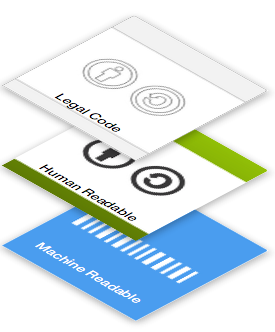
There are three layers of CC licenses. What I mean by that is that there is a base legal code (the lawyer-ese, legally enforceable part), then the commons deed (the normal person readable, non legally enforceable summaries), and finally the machine-readable part (the metadata that allows us to search for CC licenses online). When you copy the CC license code you have chosen onto your creation, all three layers will automatically be applied.
But how do you choose a Creative Commons license? Well, there are four license elements, and using those four elements, we create six Creative Commons licenses.
The four license elements are:
Attribution, or “BY”, means that people can use, adapt, and redistribute your creation with no restrictions except that they must give you attribution.
NonCommercial or “NC” means people can use, adapt, and redistribute your creation, but NOT for profit, again as long as they give you attribution.
ShareAlike or “SA” means that if people create adaptations from your creation, they must share that new creation under a similar license.
NoDerivatives or “ND” means that while people could adapt your work, they can’t share those adaptations with others.
And here are the six CC licenses we can create from these four elements (all six licenses require attribution, so I have not noted that again below).
“CC BY” allows people to use the work for any purpose.
“BY-SA” allows people to use the work for any purpose, but adaptations must be made available under the same or a compatible license.
“BY-NC” allows people to use the work for any noncommercial purpose (so, they can’t make a profit from the work or adaptations of it).
“BY-NC-SA” allows people to use the work for noncommercial purposes, but must be made available under the same or a compatible license.
“BY-ND” allows people to use the work for any purpose (even commercially) but NOT to adapt it.
“BY-NC-ND” allows people to use only the un-adapted work for noncommercial purposes.
For those of you who would like to see an more visual explanation of these elements and licenses, here is a video from censiCLICK (note that this video also explains the relationship between CC licenses and the public domain, which I will talk more about later in this post).
Creative Commons Licenses, Explained
CC licenses (like copyright) don’t affect public domain works, and should never be applied to works which are in the public domain. But Creative Commons has created icons to indicate either that a work is already in the public domain, or that a creation has been dedicated by its creator to the public domain. And while you could apply CC license to adaptations created from public domain works, Creative Commons encourages you not to do so, but to allow the adaptation to also become part of the public domain.
Here are the two Creative Commons icons indicating that a work is in the public domain:
The CC0 icon indicates that a creator has dedicated her creation to the public domain, except in those jurisdictions which don’t allow for this.
The Public Domain icon is simply a label indicating that the creation in question is free of all copyright restrictions.
To finish off my post, I wanted to share this video that talks about Creative Commons licenses and works in the public domain as they work in the world of Wikipedia and Wikimedia Commons – a little practical application, if you will.
Wikipedia Images – Public Domain Creative Commons (How-To)
Submitted for Assignment 2, Creative Commons Certificate: Copyright Law
The word “copyright” can strike fear and trepidation into the hearts of men and women, but is it really something to be afraid of?
Copyright gives creators rights to their creations so that they control how others can use their works. Sounds reasonable. If you spend a lot of time creating something, like a book or a movie or a painting, you want to be able to keep people from taking it and either passing it off as their creation or altering it in a way that you might not agree with. While in the past, creators had to jump through formal bureaucratic hoops to get copyright for their creations, today they don’t need to do anything – copyright is automatic.
In addition to giving creators control over their creations, copyright is meant to encourage creators to continue to create, and to ensure they receive attribution for their works when they are cited or performed. But what about encouraging creativity outside of the author, for example with musical performances, movies, or plays? In the video below, Dr Luke McDonagh from the Law School at City University London explains:
Is Copyright Law preventing or encouraging creativity: City University London – shaping opinion
One thing to be aware of: if you create your work as part of your work for an institution, or as part of a contract for someone else, you may have not exclusive rights over your creation. For example, if you are a faculty member at a post-secondary institution and write a book in your work time, the institution may well (depending on the country) hold copyright over that work (although, as the author, you will retain moral rights).
Copyright covers original creations, but not copies of others’ creations – typically creations that are written, recorded, saved electronically, etc. It also does not cover facts or ideas, although since creations are ideas made “concrete”, this distinction can be tricky to define. The type of creations that can be copyrighted can changes from country to country, but typically include literary/artistic works or collections of these, translations and adaptations, and sometimes computer software or industrial designs.
Trademarks and patents are related to copyright as different types of intellectual property, but trademark law covers identifiers of companies and products, for example, logos and brand names, while patent law covers inventors, giving them exclusive rights over their inventions for a limited time.
The complexity of intellectual property as copyright, patents, and trademarks, is explained in this video by Stan Muller:
Introduction to Intellectual Property: Crash Course IP 1
Eventually copyright expires, or a creator gives up her copyright, and works pass into the public domain. When this happens depends on the term of copyright in any given country. Works may also be in the public domain when they never had copyright applied to them, as with documents created by the government. When a work moves into the public domain, it can be used freely, within the constrains of the moral rights of the creator. I should note, however, that when a work passes into the public domain in one country, it may still be copyrighted in another – so be careful!
For those works not in the public domain, and not covered by Creative Commons licensing, some countries have instituted fair use or fair dealing exemptions to copyright. Fair use generally asks if the use of a creation is fair, whereas fair dealing refers to specific uses of a creation as fair. In Canada, fair dealing exemptions defined in the Canadian Copyright Act are uses for research, private study, education, parody, satire, criticism, review, and news reporting.
This short video from the University of Ottawa outlines how fair dealing works in Canada:
Copyright and Fair Dealing
Of course, copyright and copyright law are a bit more complex than I’ve outlined here, but you can always read the Canadian Copyright Act to find out more :-).
Submitted for Assignment 1, Creative Commons Certificate: What is Creative Commons
Once upon a time, there was copyright: law that gives creators control over the things that create…or does it?
Originally creators had to apply for copyright, and then apply that symbol we all know so well, to indicate their ownership over their creations. But, over time, the need to apply for copyright disappeared, and today creators are automatically granted copyright over their creations. Sounds great, right? Alas, this change actually meant that it became harder for creators to share their works, because they had no way of licensing them outside of the strict guidelines of copyright.
In addition, copyright length had over time slowly changed from ending when a creator died, to 50 years past the creator’s death. Then one day in 1998, the Sonny Bono Copyright Extension Term Act, sometimes called the Mickey Mouse Protection Act (yes, the Sony Bono Act was designed to extend Disney’s copyright over Mickey Mouse), was enacted, extending the life of copyright an additional 20 years, to 70 years beyond creator’s death.
Would copyright extensions ever end? This podcast from 2018 asks, and tries to answer, this question:
TWIT Tech Podcast
Fed up with these restrictions and ever-evolving time limits, in 2002, Eric Eldred and his attorney Lawrence Lessig challenged the Sony Bono Extension Act all the way to the Supreme Court (Eldred v Ashcroft). While they ultimately lost, Lessig did not give up the fight for open creativity, as you can see in his 2007 Ted Talks, Laws that Choke Creativity.
Larry Lessig on Ted Talks
Lessig, Eldred, and others continued the fight against laws that try to stifle sharing and creativity, and in the same year they lost their case in the Supreme Court, Creative Commons was born.
Creative Commons is first a non-profit organization that supports creators to both retain their copyright, and allow them to freely share their creations as they choose, to allow others to Retain, Revise, Reuse, Remix, and Redistribute, if you don’t mind me invoking the 5 Rs of Open Educational Resources.
Creative Commons is also recognized as a set of free to use licenses that copyright owners can use to show how they want their work to be shared. Three examples of these licenses are:
CC-BY, where BY stands for attribution, so that those who use your work, must credit you.
CC-BY-SA, where SA stands for Share Alike, meaning that others may copy, distribute, display, or modify your work as long as they then apply a SA license to their work.
CC-BY-ND, where ND stands for No Derivatives meaning that others may copy, distribute, and display your work, but they may not modify it without your permission.
And finally, Creative Commons is a global movement; according to the Creative Commons website, there are over 1.6 billion works around the world with CC licenses. In addition, The CC Global Network brings together creators, activists, and supporters to increase this number and spread the word of sharing via CC. Getting involved is easy: just sign up, decide how you want to get involved (following the Network, sharing to the Network, etc.), and you’re all set to get started on your journey.
The story of Creative Commons is not over yet – it continues, celebrating a world-wide community of sharing creators.
As I re-boot and reconfigure my PIDP program blog site into something more related to my work life and professional development interests, I thought I would start by relating my journey through the Creative Commons Certificate for Educators which begins next week. I signed up for this certificate course as part of my professional development plan to learn more about open educational practices (OER, open pedagogy, etc.), and to bring them back to my practice and my institution in general in hopes of encouraging more faculty at my institution to develop and integrate open educational practices into their own teaching.
Over the next 10 weeks I will reflect on the certificate discussions and assignments as they relate to my practice as an instructional designer in eLearning, and consider how what I learn can be brought back to the people I work with: other instructional designers, librarians, faculty, the support people in my unit, etc.
But since I don’t have a lot to reflect on yet, given that the course does not start until Monday, let me start by giving you a bit of an outline of the course and the assessments I will be completing on my journey.
Here are the topics I will be exploring, along with participants from all over the world, on this journey;
Week 1, Unit 1: What Is Creative Commons
Weeks 2+3, Unit 2: Copyright Law
Weeks 4+5, Unit 3: Anatomy of a CC License
Weeks 6+7, Unit 4: Using CC Licenses and CC-Licensed Works
Weeks 8+9, Unit 5: CC for Educators
For assessment, in addition to ungraded quizzes, I will be completing (and reflecting on here):
8 online discussions
5 Unit assignments
1 final project
I look forward to sharing my experiences with you!
For this week’s blog post, I am going to tell you a little about the chat I had with my learning partner last week via the magic that is Skype.
My learning partner works in retail management, and I am an instructional designer in eLearning. Night and day? Turns out not! Teaching people to learn new technologies and disrupting their comfortable workflow is challenging no matter what area you work in.
The Omnichannel trend new to me. According to my learning partner, omnichannel involves using technology (for example websites) to improve the overall experience for a client. After a little reading, I understand that “when a store has implemented an omnichannel approach, the customer service representative in the store will be able to immediately reference the customer’s previous purchases and preferences just as easily as the customer service representative on the phone can or the customer service webchat representative can.” (TechTarget)
According to my partner, integrating technology into a company’s workshop is often challenging as people will have to be trained to use the technology. Her example was a yoga company which traditionally focused on the “one on one” and on community. Moving to an omnichannel approach means that now this focus will have to be balanced with technology and a new workflow.
We, in our eLearning unit at our college, have similar challenges when working with faculty who are not ready to move from standing up in front of a classroom lecturing, into learning technology to support their teaching. It does, however, become easier for them to accept disrupting their workflow (and adapting a new workflow) when they begin to see the benefits for their learners (and in all honesty, for them).
Creating company culture in retail environments was the second trend in my partner’s area that we discussed. This involves companies adopting core values and a purpose beyond the bottom-line sales. This can be very disruptive for companies who do not already operate under this model, as it can be viewed as getting in the way of making money. According to Forbes, however, “[p]eople now believe that culture has a direct impact on financial performance.” (Bersin) and “[c]ompanies that focus on culture are becoming icons for job seekers”, and also have higher employee retention rates. (Bersin) It makes sense: if your company’s values match your own, and if that company actually lives and breathes those values, you are much more likely to enjoy your job and put your all into it.
Once again, I saw similarities with my discipline, specifically as it results to changing the culture of the classroom, from one where the instructor is the “sage on the stage” to more learner-directed. This, I find, is a difficult shift for some faculty, although we do have more and more new faculty who just teach this way from the beginning. I think we, as post-secondary institutions, have to look at learner retention trends from the perspective of, are we creating and supporting educational culture at our institution, what does that look like, and does it have an impact on the retention and satisfaction of our learners and faculty.
Finally, we discussed some trends in Adult Education.
My partner talked about how there is a constant introduction of new technologies into adult education these days, and we also discussed on-demand learning as a new model for education, often in the form of informal learning resources such as Ted Talks videos, blogs, vimeo, etc. Certainly, these trends are right up my alley! There are days I can’t keep up with the new technologies people are integrating into their teaching (which is ironic, given that I also work with faculty who struggle with the concept of simply setting up a gradebook in our LMS). One faculty member I work with started integrating VR into his political science classes, and this year is getting students to create and critique their own VR experiences. All ends of the spectrum, and no end in sight. Guess I will be employed for awhile!




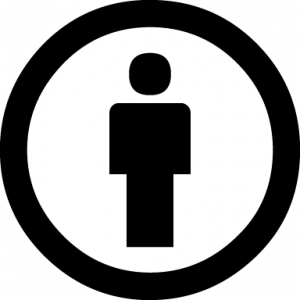 Attribution, or “BY”, means that people can use, adapt, and redistribute your creation with no restrictions except that they must give you attribution.
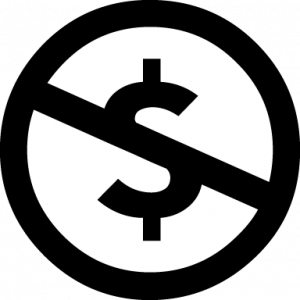 NonCommercial or “NC” means people can use, adapt, and redistribute your creation, but NOT for profit, again as long as they give you attribution.
 ShareAlike or “SA” means that if people create adaptations from your creation, they must share that new creation under a similar license.
 NoDerivatives or “ND” means that while people could adapt your work, they can’t share those adaptations with others.
 “CC BY” allows people to use the work for any purpose.
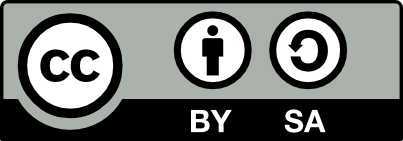 “BY-SA” allows people to use the work for any purpose, but adaptations must be made available under the same or a compatible license.
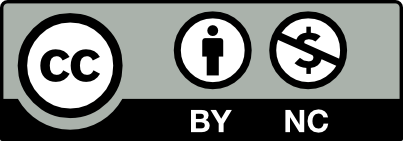 “BY-NC” allows people to use the work for any noncommercial purpose (so, they can’t make a profit from the work or adaptations of it).
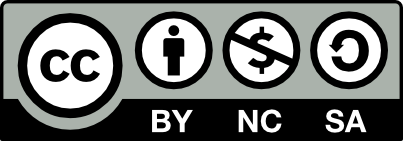 “BY-NC-SA” allows people to use the work for noncommercial purposes, but must be made available under the same or a compatible license.
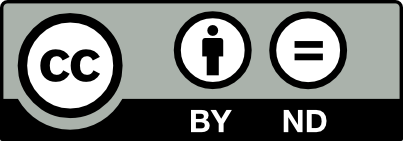 “BY-ND” allows people to use the work for any purpose (even commercially) but NOT to adapt it.
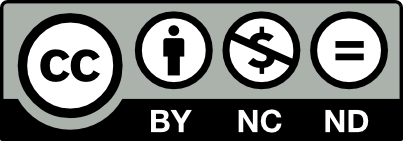 “BY-NC-ND” allows people to use only the un-adapted work for noncommercial purposes.



.jpg)
Recent Comments