When working with course developers, I always use what we at Distance Education Services call a course development blueprint document. The document I work with has been through many iterations over the past 15 years I’ve used it. For me, the core of the document is the table which I used first at the University of Regina. This has been adapted many times over the years, and upon moving to the University of Victoria, I adapted the blueprint document further to include elements of a blueprint document my colleagues were using.
Here is a screen capture of the core of the document (click on the image to see a full-size version).
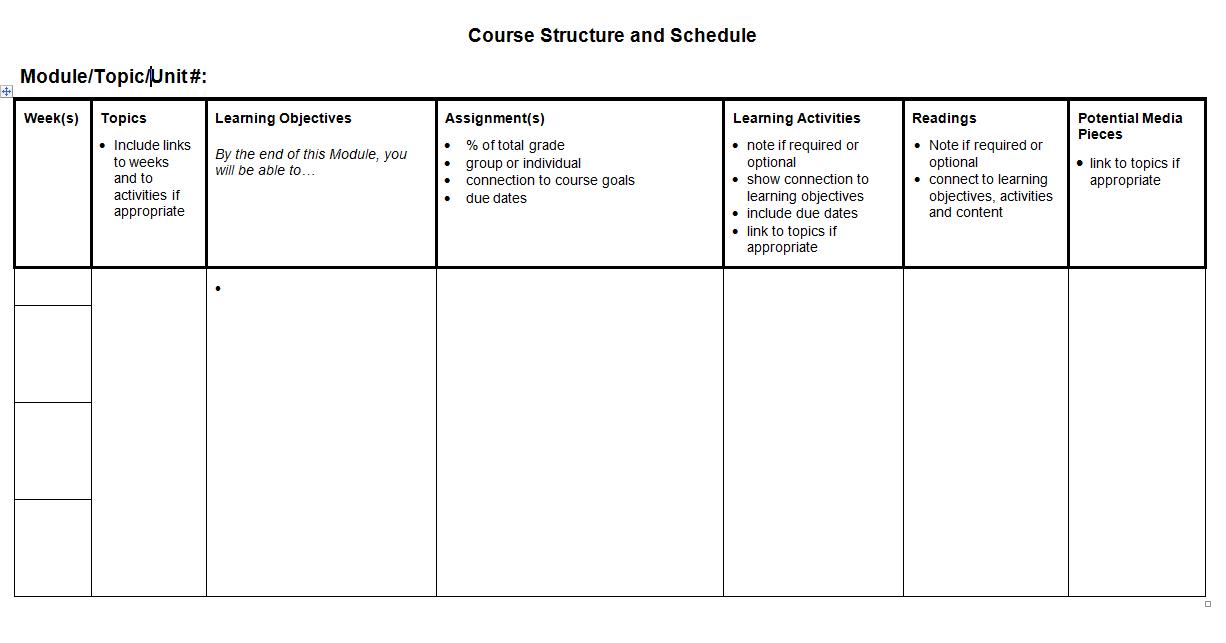
In general, I try to be as flexible as possible with course developers as they sometimes struggle to use this document, either because they are not used to planning courses out like this, or because they are not linear thinkers. I explain to them that the blueprint development process is a team process and that this model gives the other team members a clear picture of the course, one module (or unit or topic) at a glance. If they are confused by or uncomfortable with any of the language I use in the template, we discuss it in person (or over the phone) and I make minor adjustments to help them over any initial angst they may have.
The column titles are fairly explanatory, but I do walk through them with the course developers before they begin working on the document. Some of the main outcomes we are looking for once instructors have filled in a first draft are:
- learning objectives – Are they measurable? Do they link to the activities?
- assignments – Are there assignments due every week? Is there a clear link between major assignments and the course goals and module learning objectives?
- activities – Are there too many? Do they link to the learning objectives? Is there a clear relationship to the content and assessments?
- readings – Are there too many? Do they support the assessments and learning activities?
Being able to see all this information for one module at a glance is very useful given the often tight turnaround times for getting comments back to course developers, and really helps us to envision the course quite early on in the development process.
The additions I made from the University of Victoria model include pages where course developers can complete more thorough outlines of the assignments and the course modules. These are typically completed after the first draft of the blueprint (the tables for all the modules) has been approved. Here is a screen capture showing these additions (click on the image to see a full-size version).
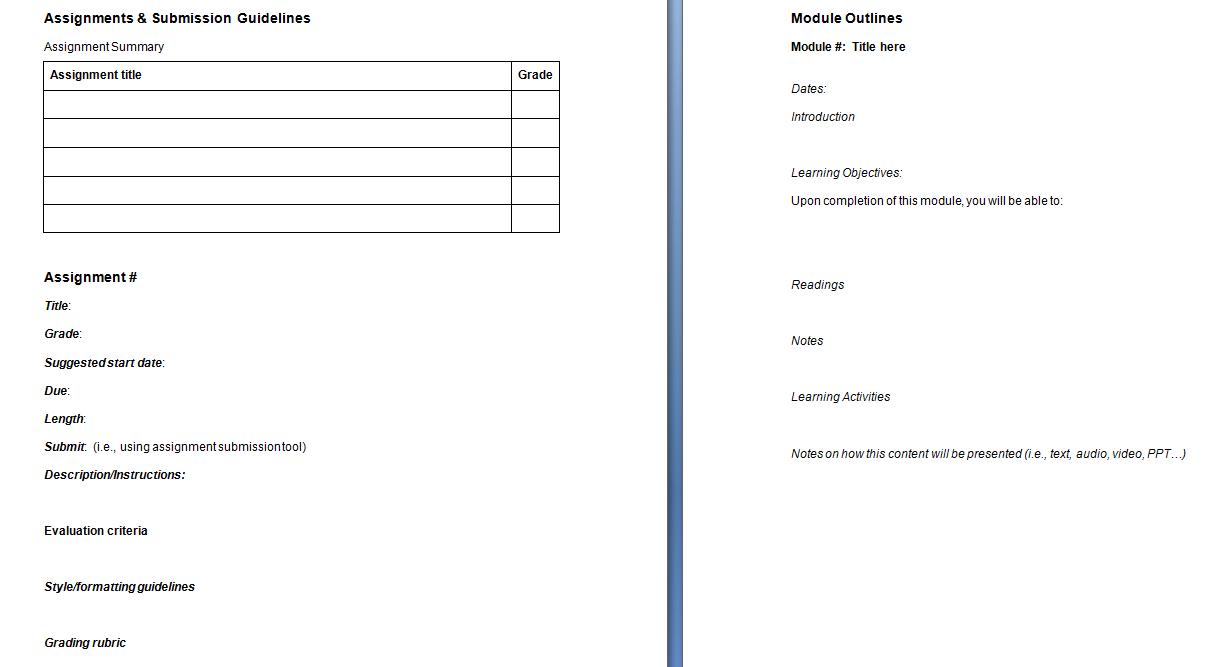
The blueprint development process is iterative, and there is much back and forth between the course development team (typically, the program coordinator and Distance Education Services instructional designer) and the contracted course developer as we move through to completion and approval of the course bluepring. We typically begin with a meeting with the course developer to explain how the blueprint works, and the development process. The instructor then creates a first draft, filling in tables for all their modules (they are also encouraged to send in a first table, and we are building that into the development process more and more, to make sure that they are on the right track). The development team then comments on the blueprint and it is sent back to the course developer with a request for a meeting to discuss the comments. Below is one final example showing a blueprint draft with comments on it ready to go back to the course developer for revisions (link opens a PDF file).
After discussing the comments, the course developer creates a final version of the tables and then moves on to flesh out the module and assignment outlines. After some more back and forth, the course developer creates a final version of the blueprint which is signed off on by the course development team, and for some programs, by a curriculum committee. We then move on to developing the course itself.
Leave a Reply